
Book Reflection: When Things Fall Apart
Reflections on When Things Fall Apart: Heart Advice for Difficult Times

Welcome to another installment of my Book Reflection series — a space where I sit down and reflect on my recent reads. In this series I answer the same questions to offload my thoughts on the book.
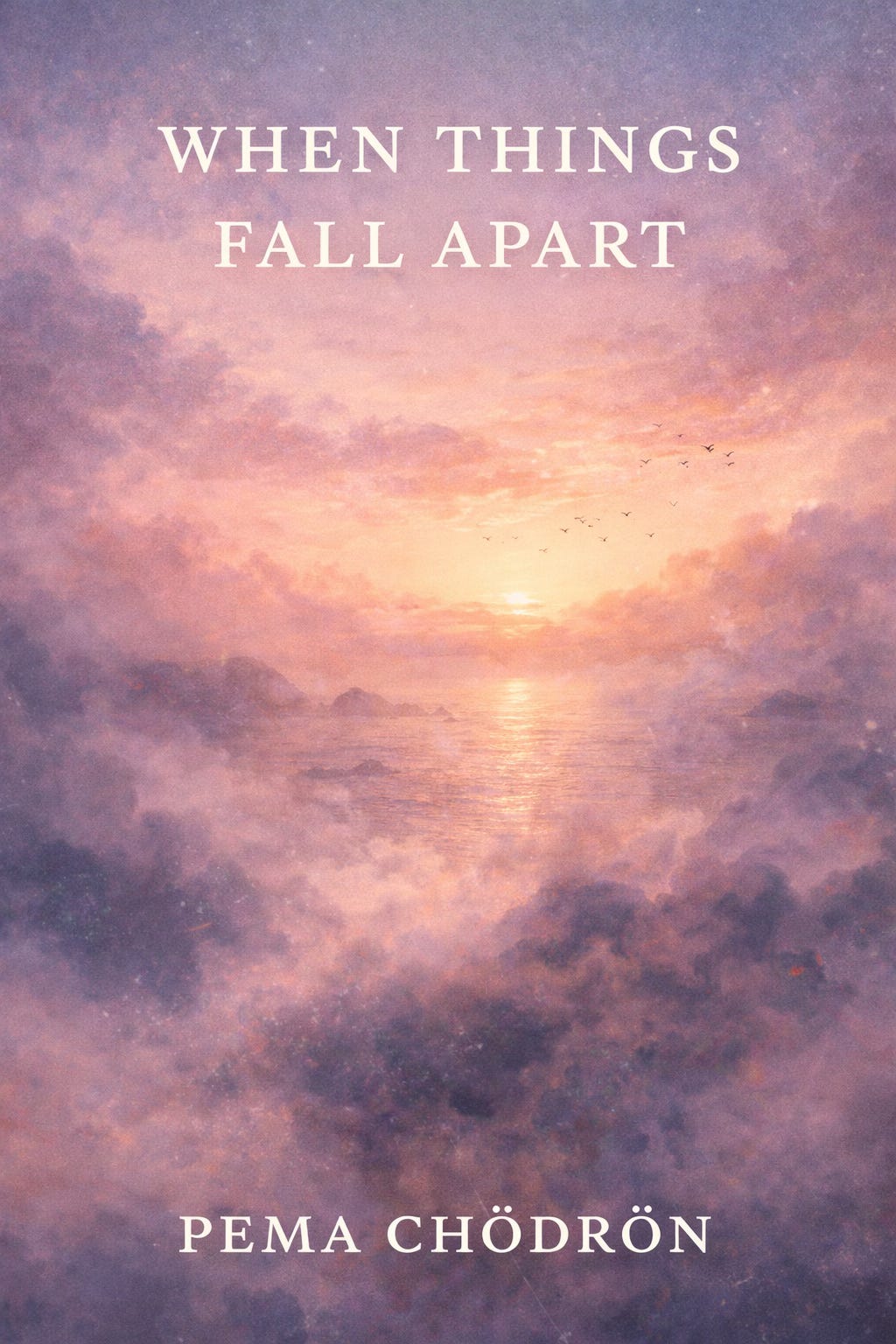
Today’s book is When Things Fall Apart: Heart Advice for Difficult Times by Pema Chödrön. I borrowed the audiobook from my local county library.
Why did I want to read the book?
I’m honestly not sure why this book originally landed on my holds list. Looking back, I added it on August 10th, though the specific reason escapes me now. What I do know is that once the hold became available, I felt compelled to read it because it arrived on my shelf at a particularly serendipitous moment.
I had recently had a very difficult conversation with someone and found myself deep—almost lost—in the thoughts that followed. In the aftermath, I felt alone and overwhelmed by the mental work required to assert boundaries and then distance myself from the consequences of that conversation, consequences that I fully wanted and still stand by.
And, of course, once it appeared on my shelf, the title alone was reason enough. It genuinely felt like things were falling apart, at least in one meaningful aspect of my life.
What was I hoping to get out of it?
Honestly, I was hoping for something that would make me feel less alone. Stable ground might be the best way to describe it. I was wrestling with the idea that I might be guilty of pushing people away, while also confronting the reality of being there for myself—standing up for myself, accepting myself for what I want and what I need. That particular incident forced a deep examination, one I didn’t quite know how to hold on my own, and I needed some kind of sounding board.
The title itself felt appropriate—almost like guidance for what to do when things fall apart.
More than that, I had already sat down and deeply explored my thoughts, actions, and the consequences, replaying what happened from multiple angles. And yet, for some reason, it still wasn’t enough. It wasn’t dissatisfaction so much as a kind of fixation—like the situation was still flooding my mind and I couldn’t find relief. I knew I needed something to help unstick me, and at that moment, this book was available.
What stood out to me most while reading?
The book is grounded in the teachings of Buddhism, and one of the first things that stood out to me was its structure. It’s made up of these almost stand-alone essays or guideposts, which made it easy to move through without feeling like it demanded a single, linear interpretation.
I felt a deep sense of relief in how the author made space for loneliness—how she allowed it, named it in different ways, and made it clear that it was not only okay, but something worthy of compassion and attention.
As I moved into the later chapters, I felt even more aligned and settled into the present moment. My favorite was the chapter on Opinion—this idea that everything becomes tangled up in opinion, in judgments of good or bad. That stickiness, or grasping, as the author would likely call it, felt like the root of so much suffering—the thing underneath it all.
The book reminded me that thoughts are just thoughts, drifting by rather than truths we must cling to. And it echoed something I had already arrived at on my own by the end of all that mental processing around the situation: that I want to endeavor to be my own best friend. That realization felt eerily similar to the kindness toward oneself—and others—that the author describes throughout the book.
What did I realize or think about differently?
One of the most inspiring elements of this book for me was the practice of breath work—specifically the idea of breathing in collective pain and breathing out space, compassion, understanding, and simple existence. When I finished the book, this was one of the first grounding ideas I shared with my husband.
It landed as a kind of two-pronged practice. First, you consider your own pain or suffering. Then, you widen the lens and consider it on a global, humanity-wide scale. You sit with it, try to understand it, and acknowledge how many others may be experiencing something similar. From there, you breathe it out—thinking of others who may need disconnection, space, closure, or simply awareness of their own pain.
In practice, I find this to be a deeply connecting exercise and a powerful way to keep myself appropriately sized. There’s an almost comforting humility to it—a kind of I’m nobody, and that’s okay, because you’re a nobody too. Not in a diminishing way, but in the sense that this is the shared wave of human existence. What’s happening—struggle, discomfort, the grasping for relief—is the most natural thing in the world.
And yet, the book made it clear that the grasping itself is what makes everything harder.
Was there anything that didn’t work for me?
Not really. I found this book to be exactly what it claimed to be. If anything, the only observation I had came after I stepped back from it. The lessons and ideas faded more quickly than I expected.
That isn’t a critique of the author so much as a recognition of my own limitations. It made me acutely aware of how a lack of continued focus or persistence allows even meaningful insights to drift away. I find it fascinating that a book can have a profound impact—guiding me through a genuinely difficult moment—only to quietly vanish once the next ordeal arrives.
Did this book connect with anything else I’ve read, seen, or experienced?
Many elements of this book reminded me of The Four Agreements. The ideas aren’t laid out as succinctly, but there are clear commonalities between the two works. I think that overlap comes from the observational stance both authors take—almost like offering a lens through which to describe human existence beyond the purely physical plane. From that vantage point, the same messages surface again and again, illuminating the persistent pain of being human.
I was also especially struck by one story the author shared. She described a time when her practice was in need of funding. Instead of responding with the effort she normally would, she chose to do something different—she did nothing. And while it may sound almost miraculous, the practice ultimately received the funding it needed, without any direct effort from her.
That story immediately brought to mind moments in my own life when I have stepped back, stopped pushing, and still watched an outcome unfold. It’s something I also notice when observing more public or visible situations. Often, what happens feels less like the result of one person’s actions and more like collective momentum—or simply the natural direction that energy wants to move.
Experiencing this, or even just witnessing it, changes a person. It cultivates a kind of confidence that isn’t rooted in the self, but in something larger—in nature, or in everything.
Would I recommend it?
I would recommend this book. I think it offers a modern take on Buddhism that feels both accessible and portable across many different circumstances. The author’s journey, humility, vulnerability, and teachings don’t read as doctrine, instruction, or anything overly rigid. Instead, they feel approachable, grounded, and—oddly—small.
That smallness isn’t a negative. It’s a strength. It feels like a reminder of just how much is happening all at once, and how impossible it is to know or hold all of it. That sense of smallness, even if it sounds diminutive on paper, isn’t cruel or dismissive. It’s human. It’s expansive. It’s the fullness of being a person.
This book isn’t about climbing a mountain of success, reaching the top, and declaring victory. It’s about the constant pursuit—the recommitment, the daily (and sometimes hourly) acknowledgment that fear, suffering, and pain grip us, and that we still have a choice in how we engage with them. Not perfectly. Not according to a template. But in a real, earnest way that, if followed, can help us confront the difficulties, thoughts, and fears that may have paralyzed us for our entire lives—or at least for a lifetime we can easily imagine belonging to someone else.
Final Reflection
This book arrived at a time when I was beginning to feel a kind of existential loneliness. That loneliness has only deepened since reading it. In the time that followed, I went through yet another painful detachment from a friendship—one that further frayed my trust in people I’ve known for years. The details of what happened were so small, almost minute, and yet enormous in their impact.
Of course, it isn’t purely the loss of friendship that has fueled this feeling. It’s also the ongoing observation and witnessing of institutions and systems that aren’t designed to hold human lives, but rather to do the opposite—to reduce people into functional, emotionless cogs. There’s a pervasive belief that our “logical” or “rational” brains contain all the answers, that they are the key to progress, purpose, and even love. That belief feels not just incomplete, but deeply damaging.
Lately, it feels as though there are hundreds of parallel simulations running at once, forced to intersect in shared spaces—the grocery store, the holidays, everyday rituals. And yet even in those moments of overlap, it feels like ships passing in the night. Not true intersection, just proximity. A kind of parallelism that, in revealing itself, exposes the existential loneliness of this moment in time.