
Book Reflection: The Singularity is Nearer
Reflections on The Singularity is Nearer: When We Merge with AI by Ray Kurzweil

Welcome to another installment of my Book Reflection series — a space where I sit down and reflect on my recent reads. In this series I answer the same questions to offload my thoughts on the book.
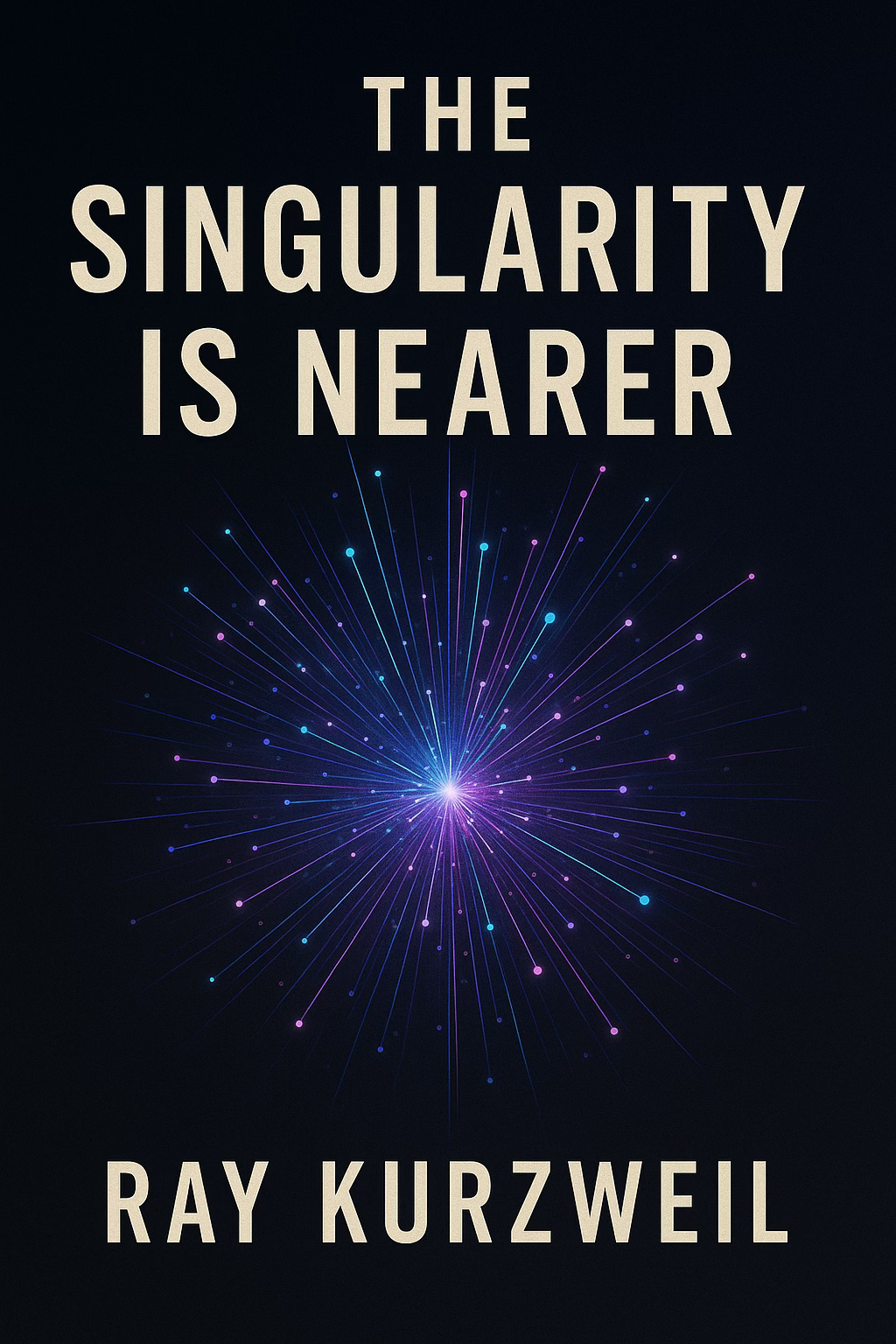
Today’s book is The Singularity is Nearer: When We Merge with AI by Ray Kurzweil (2024). This book is an update/continuation of his book The Singularity is Near which was originally released in 2005. I borrowed the audiobook from my county library.
Why did I want to read the book?
After finishing Nexus by Yuval Harari, I found myself wanting a distinctly different perspective on humanity’s future with AI—something more forward-looking, and perhaps even aspirational. I had been hearing the term the singularity pop up more frequently in articles and other places on the internet, usually without much clarity or shared understanding. Since no one provides an in-depth description when they use the term, I thought it would be useful to go to the source (or a source) of the concept.
What was I hoping to get out of it?
I was looking for a deeper understanding of what the singularity actually means—beyond just the way it’s casually referenced in headlines and tech circles. I’ve had this growing sense that something massive is already unfolding with AI, and I wanted to know how someone like Ray Kurzweil, who has been talking about this for decades, frames what’s happening now and what he believes is coming next. Since the book openly asserts that humans will merge with AI, I was curious what exactly that entails—not just as a technical possibility, but as a vision of where we’re heading as a species.
What stood out to me most while reading?
One of the most striking things was just how long Ray Kurzweil has held this vision. He’s been forecasting and refining these ideas for decades, and many of his earlier predictions have already come true. There’s a grounded confidence in the way he talks about the future—rooted in continuity rather than speculation. And the fact that his original timelines have held up without major revision makes his outlook feel more plausible than far-fetched.
I was also drawn to the clarity and precision of his projections. Naming 2029 as the year for AGI (although he has said more recently that might be sooner) and 2045 for the singularity might sound bold, but it felt tangible in a way that surprised me. Now that it’s 2025, and I’ve already lived through 20+ years of adulthood, those future dates don’t feel distant or fuzzy,—they feel within reach and include some definition.
And perhaps most gratifying for me was how much quantitative evidence Kurzweil includes. The charts and datasets aren’t just there for effect—they serve as scaffolding for his arguments. He engages seriously with how we measure technological and societal progress, often questioning the traditional indicators and offering more meaningful ones. That analytical grounding made the book especially satisfying to read, and gave his predictions added weight.
What did I realize or think about differently?
One of the most pressing realizations I had was how much I want to spend time with the data and charts Ray presented. Not just to glance at them or rely on someone else’s interpretation—but to actually work with them myself. Many of his charts are logarithmic, and while that’s necessary for capturing exponential progress, it also obscures just how fast things are changing unless you’re fluent in that visual language. I want to explore other ways of communicating those trajectories—ways that might make the future feel more graspable to more people.
I also appreciated the sheer range of scientific domains Ray covered—medicine, materials science, transportation, energy—and how clearly he outlined the ways AI is already integrated into those spaces. He didn’t linger on the obvious consumer tech topics like social media or shopping algorithms (which I’ve heard plenty about). Instead, he focused on how AI is accelerating meaningful scientific breakthroughs and how that trend will continue. There was a refreshing optimism in that, and it gave me a more concrete sense of where we are and where we’re going.
One concept that stuck with me was Ray’s framing of human evolution as increasingly external. He makes a compelling argument that biological evolution simply can’t keep pace with the speed of our knowledge and innovation. So instead, our evolution is taking place outside the body—through our tools, our technology, and increasingly through AI. His analogy of smartphones as an extension of the human brain isn’t new, but he articulates it in a way that feels especially clear and compelling. It reminded me that this isn’t just about technology — it’s about what kind of species we’re becoming.
Was there anything that didn’t work for me?
As the book progressed, I found myself realizing that Ray Kurzweil wasn’t building toward his predictions—he was already standing firmly within them. He doesn’t spend much time laying out a path or slowly scaffolding the reader toward his vision of the future. Instead, he speaks from the assumption that his predictions are simply what will happen—not with arrogance, but with a matter-of-fact clarity that implies the future is already written.
That approach didn’t bother me personally, but it did make the book feel a bit lopsided. Maybe 20% of the content is focused on establishing the groundwork—the data, concepts, and evidence leading up to the present—while the remaining 80% dives straight into life leading up to and beyond the singularity. For readers who prefer more rigor before arriving at bold conclusions, it could feel like there’s a gap between the premise and the proof. There’s a certain level of trust you have to place in Ray—and not everyone will be comfortable making that leap without a more measured build-up or external corroboration.
Did this book connect with anything else I’ve read, seen, or experienced?
Interestingly, it brought me back to my early college days—especially when I was pursuing a degree in physics. The theoretical and scientific nature of Ray’s work echoed many of the questions I was drawn to back then. His discussion of exponential progress, computing, and information theory tapped into familiar territory and made me reflect on how those interests shaped my foundation, even if I didn’t fully realize it at the time.
I also appreciated his references to thinkers like Steven Pinker and Daniel Kahneman—both of whom I’ve read before. It was a nice reminder to revisit their work and see what new perspectives they might offer now. While Ray operates more as a futurist and theoretical technologist, Pinker and Kahneman tend to focus more on philosophy, psychology, and human behavior. The contrast between them helped me stay grounded in the multidimensional reality of the moment we’re living through. It’s not just about the capabilities of AI—it’s also about how humans will perceive, adapt, and respond.
Would I recommend it?
Yes, I would recommend The Singularity is Nearer. It’s a fast-paced read that’s especially useful for anyone who struggles to imagine a future with AI. Kurzweil offers vivid descriptions of what may come to pass—descriptions that aren’t abstract or overly speculative, but rather grounded extensions of our current technological capabilities. They’re written in an accessible way, even when the subject matter is immense in scale.
That said, there are mathematical elements that veer into the territory of proofs and unimaginably large numbers. But I wouldn’t let that scare anyone off. If anything, the sheer absurdity and scale of those numbers help reinforce just how undefined and uncharted this territory really is. It leaves you with a clearer sense of both the pace of change and the magnitude of what we’re stepping into.
Final Reflection
I genuinely really liked this book. It reminded me of being 18 to 22, back in college. I appreciated how it stepped outside the noise of “right now”—meaning social media, politics, and the evils of Big Tech—and instead focused on AI in a much more holistic, systems-level way.
Ray stays in his lane. He doesn’t ignore or downplay the potential threats of AI. In fact, he names them clearly, often backing them up with specific examples or evidence of people already working to address them. That gave the book a grounded feel, even when it veered into the fantastical.
After finishing it, I immediately went searching to see if he’d given any recent talks about the book. He has. But from my perspective, his speaking persona doesn’t match the tight, clean pacing of the written version (which I was able to listen to at 1.75x without issue). If anything, I wish there were a punchy, well-produced video that condensed these ideas into something easily shareable for a more mainstream audience. Because the vision in The Singularity is Nearer is expansive—and worth getting out of the AI echo chamber to talk about.