

Welcome to another installment of my Book Reflection series — a space where I sit down and reflect on my recent reads. In this series I answer the same questions to offload my thoughts on the book.
(If you’ve been wondering why I went silent for a period of time it’s because I listened to all 7 Harry Potter full cast edition audiobooks.)
Today’s book is The Scout Mindset: Why Some People See Things Clearly and Other’s Don’t by Julia Galef. I borrowed the audiobook from my local county library.
Why did I want to read the book?
I was searching for book recommendations that might help me adjust how I think. I’m also someone who deeply appreciates clarity—a theme that has become increasingly prominent as I’ve explored it over the past few years. The book’s tagline, Why Some People See Things Clearly and Others Don’t, immediately caught my attention. It felt like exactly the kind of question I wanted to spend time thinking about.
What was I hoping to get out of it?
I was interested in the author’s perspective on what it really means to “see things clearly.” I also wanted to test myself—to better understand how clearly I think and where my own blind spots might be.
If I remember my original request for book recommendations, I was specifically looking for something that felt optimistic and actionable rather than overly theoretical, abstract, or condemning. I know I probably overuse the word framework, but that’s exactly what I was hoping to find: a practical framework for thinking more clearly and evaluating my own reasoning.
What stood out to me most while reading?
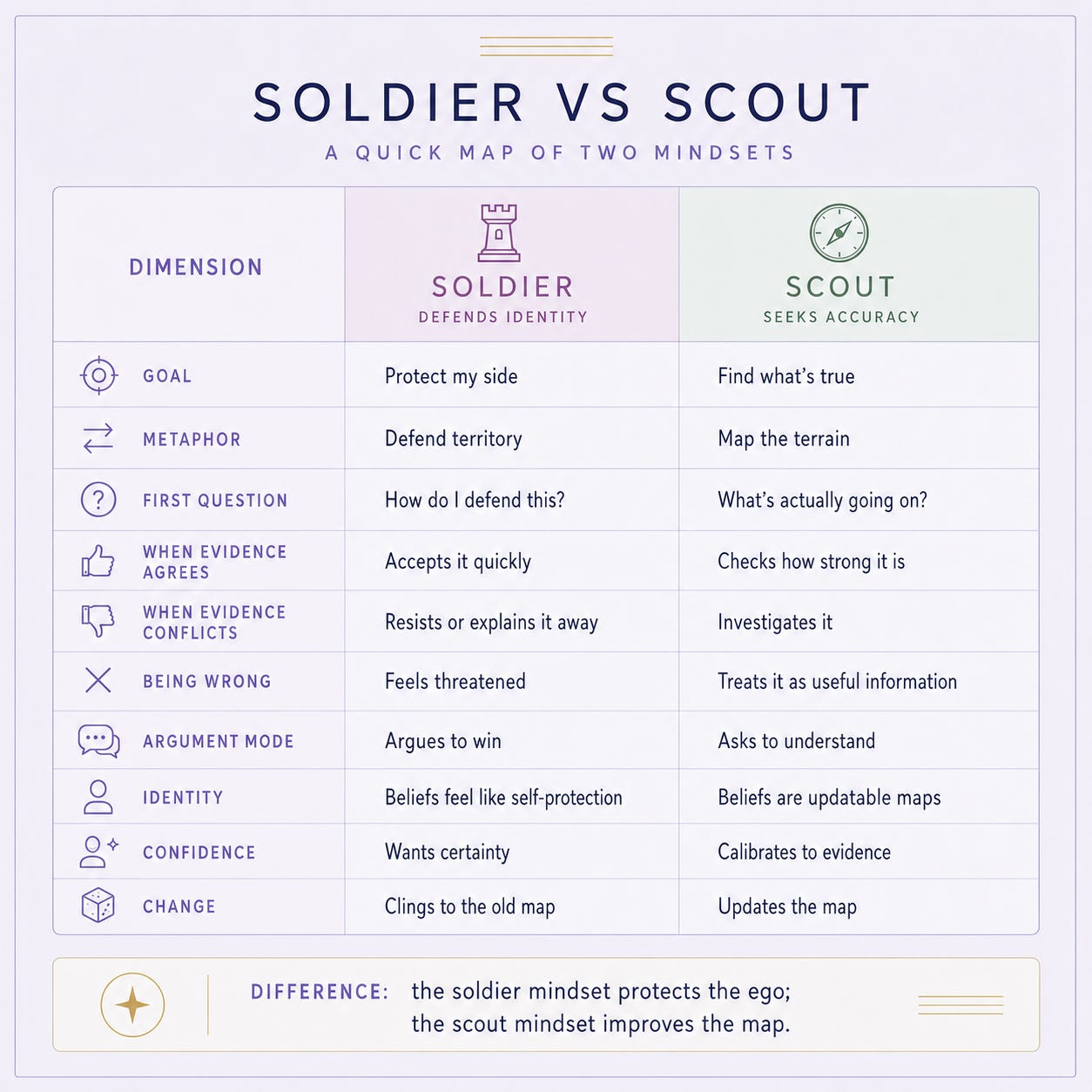
The framework Julia Galef uses to explain different modes of human thinking is one of the most approachable and useful I’ve encountered. She distinguishes between the Soldier mindset and the Scout mindset. At its heart, the Soldier mindset is about defending identity, while the Scout mindset is about seeking accuracy.
Very early in the book, she breaks down each mindset in remarkable detail—its goal, field metaphor, first question, behavior when evidence agrees or disagrees, how it responds to being wrong, what arguments look like, how identity shapes it, how confidence is expressed, and how each reacts to change. I was so taken by this framework that I even created a graphic to help crystallize the concepts and keep them top of mind.
What impressed me most was how well that foundation carries through the rest of the book. Galef covers a wide range of topics, but everything continues to map back to the core distinction between Soldier and Scout. She has a talent for taking ideas that often feel vague or overloaded and separating them into more precise, useful concepts.
A great example is motivated reasoning. Rather than simply presenting it as a flaw, she explains why humans naturally engage in it and the situations where it can actually be valuable. By defining it more clearly, she gave the concept its own space in my mind, making it easier to recognize both in myself and in others.
I also particularly appreciated her discussion of confidence. She distinguishes between epistemic confidence—confidence that your beliefs are accurate—and social confidence—confidence in how you present yourself to others. I’ve always found confidence to be a surprisingly nuanced concept, something that’s constantly being calibrated depending on the situation. Seeing those two forms separated so clearly helped me think about where I might intentionally dial my confidence up or down, while also giving me a better understanding of how my confidence is likely perceived by other people.
What did I realize or think about differently?
Toward the end of the book, Galef discusses the idea of holding identity lightly. One observation that has stuck with me is her suggestion that you can often tell when an identity has become overdeveloped: once there are t-shirts and members-only clubs, it’s probably gone too far. That idea immediately gave me a new lens for observing not only myself, but also the communities and ideas I encounter.
She also talks about how the groups we surround ourselves with shape our thinking. One example she uses compares acting school with graduate school, illustrating how different environments create different relationships with mistakes. That resonated deeply with one of my own recurring experiences—what I jokingly call the evil pie chart.
If you’ve spent any time learning data visualization, you’ve almost certainly heard that pie charts are terrible. The argument is usually that humans struggle to compare slice sizes and that pie charts are frequently misused outside of true part-to-whole relationships. While there’s certainly truth to those criticisms, I’ve never fully adopted the blanket dislike. In fact, one of the most impactful visualizations I created early in my career was a pie chart that helped drive an organizational change.
Because of that, I’ve often felt slightly out of step with the broader data visualization community. It’s one of those topics that almost feels undiscussable—as though admitting that pie charts can sometimes be useful marks you as someone who “doesn’t get it.”
Reading this book helped me understand why that happens. The opposition to pie charts has, in some circles, become less of a practical guideline and more of an identity marker. Once that happens, it becomes harder to have nuanced conversations about when a visualization is or isn’t appropriate. Ironically, that type of stance can also make it more difficult for new people to learn about something (in this case data visualization).
That realization extended far beyond data visualization. It made me wonder how many other beliefs I encounter—my own included—are being held because they’re useful, and how many are being defended simply because they signal membership in a particular group.
Was there anything that didn’t work for me?
Because the book relies on such concrete comparisons and mental models, I think listening to it as an audiobook put me at a slight disadvantage. Some of the concepts felt like they were asking to be visualized. I haven’t looked to see whether the print edition includes visuals, but after creating my own Soldier vs. Scout graphic, I found myself wishing there were more simple visual imagery throughout the book to help reinforce the ideas.
The other aspect that gave me pause was the author’s repeated references to Effective Altruism toward the end of the book. To me, EA is a thing that exists and something I don’t have a strong opinion on. However, on the internet, I think it has become more polarizing.
What stood out more was that, as the references accumulated, I found myself wondering whether the author had a small blind spot of her own. Much of the book argues for holding beliefs and identities lightly, yet I occasionally felt that her identification with EA came across a bit more strongly than the mindset she had spent the book advocating. Whether that’s a fair assessment or not, it left me reflecting on how difficult it is for any of us—including authors writing about clear thinking—to fully escape the pull of our own identities.
Did this book connect with anything else I’ve read, seen, or experienced?
More than anything, this book connected with how I already try to move through the world. I’ve always felt a significant amount of uncertainty about what I know, which is one of the reasons I’m so drawn to numbers, data, and evidence. For me, they’re tools for reducing uncertainty—not necessarily to arrive at absolute certainty, but to become a little more confident that I’m seeing reality as it is.
That same instinct is why I enjoy collaborating with other people. I often find myself trying to build a shared understanding of the truth rather than simply persuading someone that I’m right. Reading The Scout Mindset gave me neutral language for something that has been my operating model for years. I certainly don’t live up to it all the time, but it’s the direction I’ve been trying to move.
The book also felt deeply relevant to the level of polarization we’re experiencing today—on the internet, in politics, in professional communities, and in everyday culture. Without needing to point to any particular cause or ideology, it gave me a useful way to interpret what I’m seeing. So many public disagreements feel less like people searching for what’s true and more like people defending identities, teams, or tribes. They’re stuck in Soldier mindset, down in the trenches, protecting a position rather than exploring reality.
That doesn’t mean Scout mindset is easy. In many ways, the book reinforced just how difficult it is. But it also left me feeling that if more people genuinely aspired to it—even imperfectly—we’d probably have better conversations and make better decisions together.
Would I recommend it?
Yes, I would absolutely recommend it.
At around six hours, it’s a very approachable read (or listen), but more importantly, it’s remarkably concrete. The book is organized in a way that makes it easy to revisit specific ideas, whether you’re thinking about being wrong, dealing with uncertainty, understanding confidence, or recognizing when your own thinking has shifted into Soldier mindset. It feels less like a book you finish once and more like a reference you can return to when you need it.
For anyone interested in analysis, decision-making, or simply making better sense of the world, I’d consider it a foundational read. It gives permission to ask questions, update your mental map when new evidence appears, and explain that approach to other people without it feeling like a personal attack.
I also think the timing of this book is particularly relevant. In a world that feels increasingly saturated with endless online debates it provides a constructive framework for entering disagreements with curiosity instead of certainty. Rather than teaching you what to think, it offers a practical way to think more clearly. If more people in organizations adopted even a little of the Scout mindset, I suspect we’d have more productive conversations, make better decisions, and spend less energy defending positions simply because they’re ours.
Final Reflection
One of the strongest indicators that a book has had an impact on me is whether I continue using its ideas after I’ve finished reading it. In this case, I created my own Soldier vs. Scout graphic to crystallize the framework and give myself something I can quickly refer back to. I’m even considering incorporating the framework into the instructions I give AI, using it as a way to help me think through difficult questions and recognize when I might be defending a position instead of updating my map.
To me, that speaks to the utility of the analogy. It’s simple enough to remember, practical enough to apply, and flexible enough to carry into completely different contexts. Of course, as the book itself would encourage, I’ll happily update my map if I find a better framework someday.
Overall, The Scout Mindset is a thoughtful, highly approachable read that provides a set of practical thinking tools rather than just ideas to admire. I can easily imagine keeping a copy on my bookshelf—not necessarily to reread cover to cover, but to revisit individual chapters whenever I need a reminder about uncertainty, confidence, identity, or what it really means to seek accuracy.